


No GIL,
Real Gains
Porting a C++ Python extension to free-threaded Python 3.14.
Auxten Wang · Technical Director @ ClickHouse · Creator of chDB
PyData PyCon Yerevan · 24 Jul 2026
zero subprocesses

Auxten Wang
@auxten · auxten.com
Killing the GIL: 30 years of attempts
Every attempt died on that bar — until one didn't. Here's each autopsy.
Greg Stein's free-threading patch
One big lock → a small lock on every mutable structure. Python 1.4.
One survivor: PyThreadState — still in CPython today.
=== comp.lang.python · 1996 ===
From: Greg Stein
Subject: free threading patches
for Python 1.4
A patch set that removes the
global interpreter lock and
guards dicts, lists, modules…
with fine-grained locks.
> benchmark: ~2x slowdown_
Adam Olsen's python-safethread
Sidestep the locks: every object is owned by one thread. Sharing only through monitors.
Larry Hastings' Gilectomy
Make every refcount atomic. Now each Py_INCREF is a fight between CPU cores.
18.9× slower on 7 cores. Abandoned.

Larry Hastings · PyCon 2016, Portland
Sam Gross' nogil fork
Don't make refcounts atomic — redesign them so the common case never leaves the thread.

Sam Gross · author of the nogil fork & PEP 703
The one that landed: free-threaded Python
PEP 703 · 3.13
GIL becomes optional. Experimental, ~40% single-thread penalty.
PEP 779 · 3.14
Officially supported. Specializing interpreter on; penalty ~5–10%.
Opt-in build
Separate binary python3.14t; wheels get a cp314t suffix.
$ python3.14t -c "import sys; print(sys._is_gil_enabled())"
False # threads now run Python bytecode in parallelWhy it matters: Python finally spans the cores
Single-core speed plateaued; machines got wider. Free-threading lets one process use the width.
Agent builders
Parallel subagents in one process — shared models. No pickle, no IPC.
Desktop apps
Responsive UI + truly parallel background work.
Servers & data tools
One copy of the model — not 16 workers × 16 copies.
20 years of dodging the GIL: the four escape hatches
Drop to C
NumPy & SciPy: Py_BEGIN_ALLOW_THREADS around every kernel.
Thread pool below Python
TensorFlow & PyTorch: C++ thread pools, CUDA streams — the graph runs outside Python.
Fork & pickle
multiprocessing, joblib, DataLoader workers — every value crosses by copy.
Compile it away
with nogil:      # Cython
    crunch(buf)

@njit(nogil=True)  # Numba
def crunch(buf): ...
Leave the interpreter entirely — then threads are free.
It works — until the work is Python
Extensions get nothing for free
$ python3.14t -c "import _chdb"
RuntimeWarning: The global interpreter lock (GIL) has been enabled to load
module '_chdb', which has not declared that it can run safely without the GIL.Touching an object used to be free. Not anymore.
The black magic that keeps 3.14t fast
Biased refcounting
Two counters. The hot one never leaves its core.
Immortal objects
The hottest objects opt out of counting entirely.
Per-object locks
Mutations lock one object, not the world — deadlock-proof critical sections.
Lock-free reads
dict/list reads stay wait-free on the hot path.
Every big library re-did its object plumbing
So who has opted in? (July 2026)
of the top 360 compiled packages on PyPI now ship free-threaded wheels
219 / 360 · hugovk.dev/free-threaded-wheels · 15 Jul 2026
The scientific stack led the way. Chances are your daily imports already run free-threaded:
…and who hasn't (yet)
Our patient — chDB: a rocket engine on a bicycle
The ClickHouse engine, embedded in your Python process — SQLite-simple, built to scan millions of rows.
# pip install chdb
import chdb
chdb.query("SELECT count() FROM file('hits.parquet')")
It drops into your Python data stack
70+ formats
Parquet, CSV, JSON, Arrow, ORC — read & write, no converters.
Zero-copy Pandas / Arrow
Query a live DataFrame in place: SELECT … FROM Python(df)
Python UDFs
Your Python functions callable from SQL — keep this one in mind too.
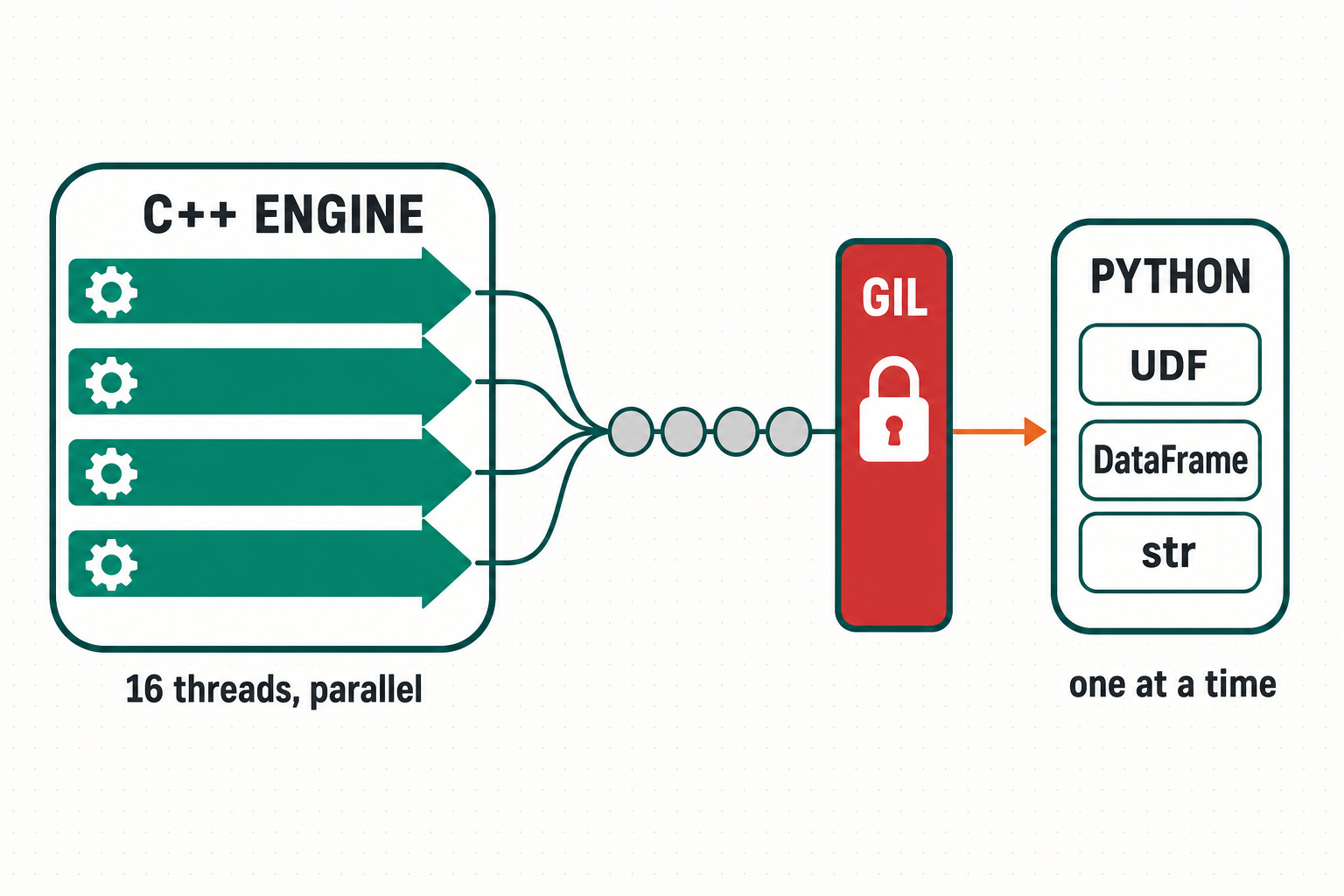
Parallel engine × serial glue = serial query
The engine scales fine — every stream just queues on the GIL to touch Python.
Three changes that made no-GIL pay off
Move Python UDF execution in-process
Kill the subprocess pipeline first.
Declare the module GIL-independent
Py_mod_gil_not_used — then survive the audit it implies.
Drop to low-level CPython string access
On hot paths, the friendly Unicode APIs had to go.
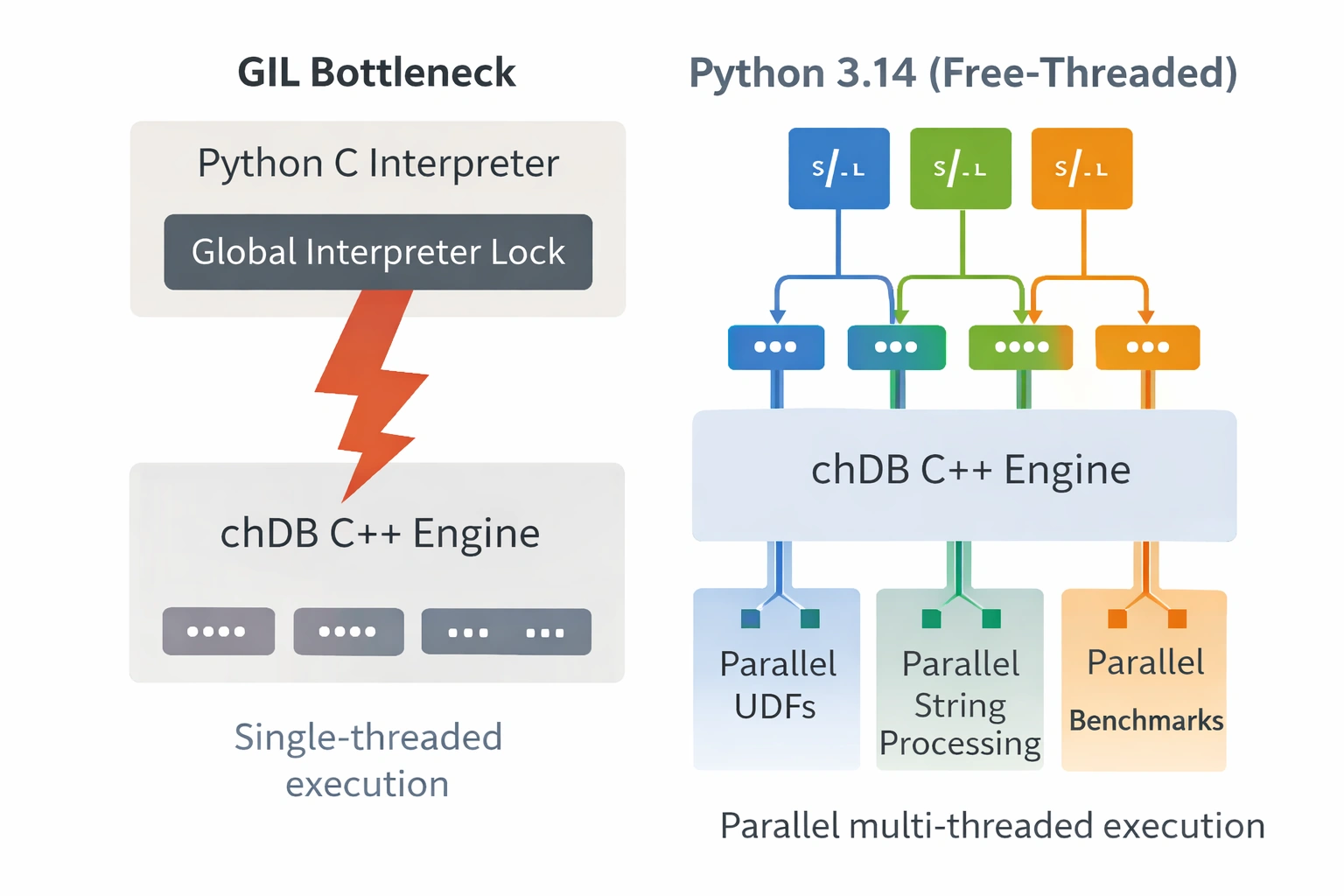
Plus the honest part: what broke, what didn't scale, and where the stable ABI stopped being an option.
UDFs ran out of process
The old decorator wrote a script + XML config; the engine forked Python and piped rows through it as text.
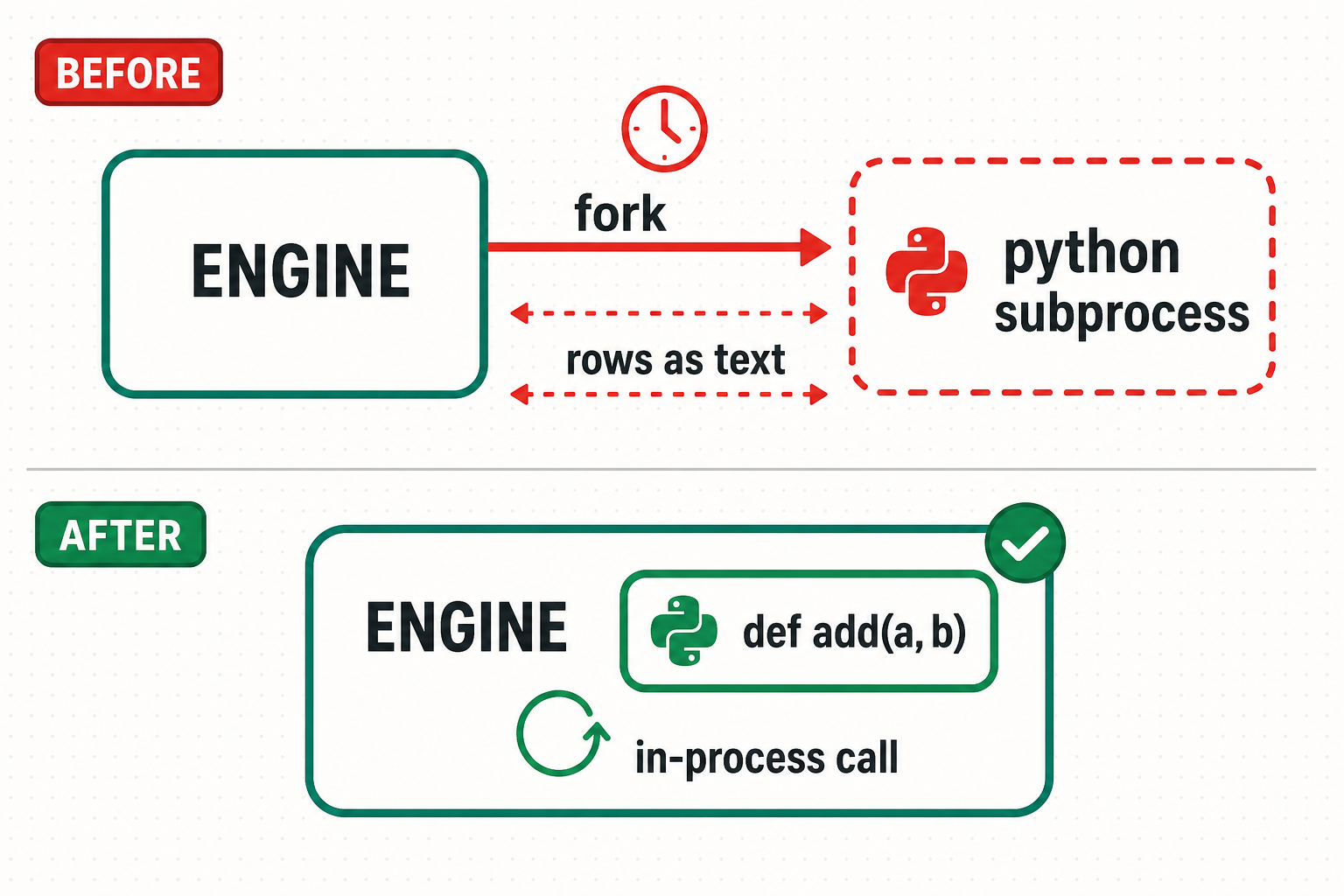
After: native in-process UDFs
C++ holds your py::function and calls it from the engine pipeline. Typed args, zero subprocesses.
import chdb
from chdb.sqltypes import INT64

@chdb.func([INT64, INT64], INT64)  # in-process
def add(a, b):
    return a + b

chdb.query("SELECT add(x, y) FROM t")
// C++: PythonScalarUDF::executeImpl
// (called from engine worker threads)
py::gil_scoped_acquire acquire; // <-- THE lock
for (size_t row = 0; row < rows; ++row)
{
py::tuple py_args = box_arguments(row);
py::object out = func(*py_args); // your fn
insert_into_column(result, out);
}This is what no-GIL was made for
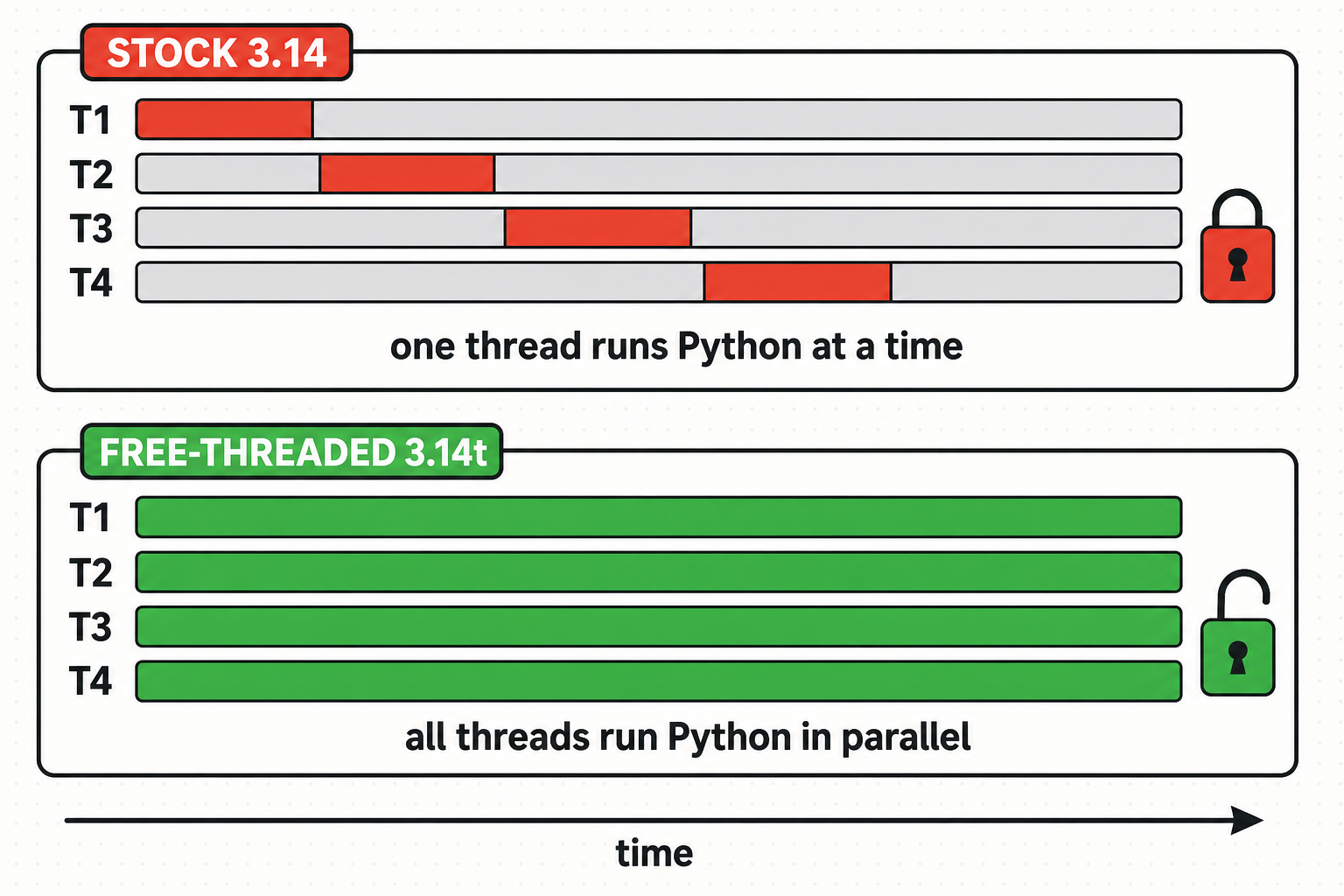
4M-row scalar UDF, 16-core x86_64, best of 3 — post-fix numbers, landing in 26.5.1.
Opting in: one line — and an audit
PYBIND11_MODULE(_chdb, m, py::mod_gil_not_used()) // that's the whole declarationThe line is easy. It's a claim about every global in your codebase — so the real work was a state audit:
The nastiest bug: lazy init on a GIL-free thread
Trigger
First NULL in a string column → a scan thread lazily imports pandas.NaT… with no Python thread state.
Crash
Segfault deep inside the allocator — nowhere near the actual bug.
Hang
Then the fatal-signal handler deadlocks. No traceback, no exit. The query just hangs, forever.
Strings are the hot path — go straight to the bytes
Millions of strings cross the C++/Python border per query. Friendly Unicode APIs cost a call per value — so on 3.14t we read CPython's memory directly:
if (PyUnicode_IS_COMPACT_ASCII(obj)) {                    // most analytical data
    data = (const char *) PyUnicode_1BYTE_DATA(obj);      // direct pointer, no copy
    len  = PyUnicode_GET_LENGTH(obj);
}
// ...cached-UTF8 / compact / legacy fallbacks omittedThe biggest win: skip PyObject entirely
pandas 3.x str columns are Arrow-backed: plain C buffers, scanned directly on all streams — no GIL at all.
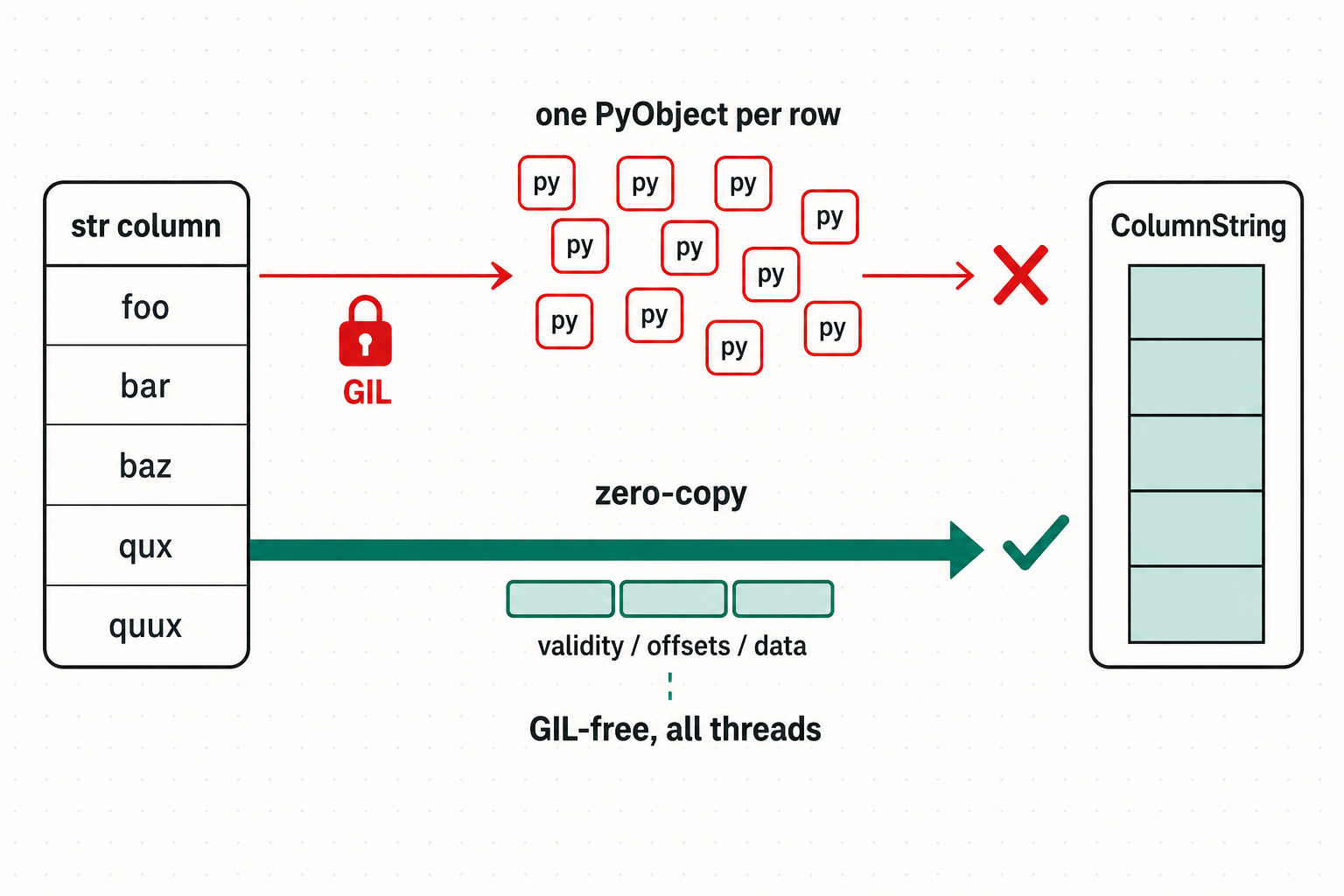
ClickBench, 50M-row hits DataFrame, all queries, pandas 3.x, hot run · 10.9× total · geomean 4.5× · string-heavy up to 64×
What broke, what surprised us
Measured, not vibes
The free-threading win, isolated: an object-dtype scan (5M rows) that must read one PyObject per value — exactly where the GIL used to serialize every stream.
chdb-core 26.5.1-rc.2 cp314t wheel, CPython 3.14.6 vs 3.14.6t, 56-vCPU Xeon E5-2690v4, min of 6 runs. Both rc sharp edges are fixed for 26.5.1: the FT UDF collapse past 8 threads (chdb-core#128 — per-row tuples were feeding stop-the-world GC storms) and the cold-start hang (#131). That's what benchmarks are for.
When does no-GIL actually help?
It pays when…
It doesn't when…
You don't need to port anything. Try it this week:
# 1 · install
uv python install 3.14t
uv venv --python 3.14t && uv pip install -r requirements.txt
# 2 · run YOUR tests, unchanged — watch for the GIL warning
python -m pytest
# 3 · trust, but verify
python -c "import sys, yourapp; print(sys._is_gil_enabled())"How to help the community
Three takeaways
Free-threading reaches you through your dependencies.
Your job isn't porting — it's testing on 3.14t, verifying with sys._is_gil_enabled(), and reporting what breaks.
Restructure before you parallelize.
In-process beats out-of-process; zero-copy beats lock-free; then free-threading multiplies what's left.
The GIL was an amnesty, not a feature.
3.14t revokes it. The bugs it exposes were already yours.
Take 3.14t for a spin
pip install chdb          # try the engine
python3.14t your_tests.py # try the future
Code & slides
github.com/chdb-io/chdb
auxten.com · @auxten
Read more
py-free-threading.github.io
PEP 703 · PEP 779 · chDB docs: clickhouse.com/docs/chdb
Now it's our extensions' turn.
Q&A
github.com/chdb-io/chdb · auxten.com
No GIL, real gains — thank you, Yerevan!