PyCon Indonesia 2026
chDB

Federated
by Default

Building Agent Data Pipelines Without ETL
Auxten Wang · ClickHouse · Creator of chDB@auxten
ABOUT02 / 16
Auxten Wang

Auxten Wang

@auxten · auxten.com

Technical Director @ ClickHouse
Creator of chDB — acquired by ClickHouse in 2024
Builds embedded databases & agent data tooling
Ex-Shopee · CovenantSQL · Baidu · Qihoo 360
chDB
ClickHouse
THE AGENT03 / 16

You're building a support agent

 tools.py
@tool get_orders(user_id)   # spend history
@tool get_customer(user_id) # who is this?
@tool get_tickets(today)    # what's hot?
Every tool call is a
data question.
An agent is only as good as the data its tools can reach.
THE PAIN04 / 16

Three answers. Three worlds. Zero reach.

CLOUD

orders.parquet · on S3
5,000 rows · never loaded

ARCHIVE

crm_exports.tar
users_*.csv trapped inside

PROCESS RAM

tickets DataFrame
fetched from the API just now

YOUR AGENT

[ •  • ]  so… where's the data?
The model isn't the bottleneck. Reach is.
THE REFLEX05 / 16

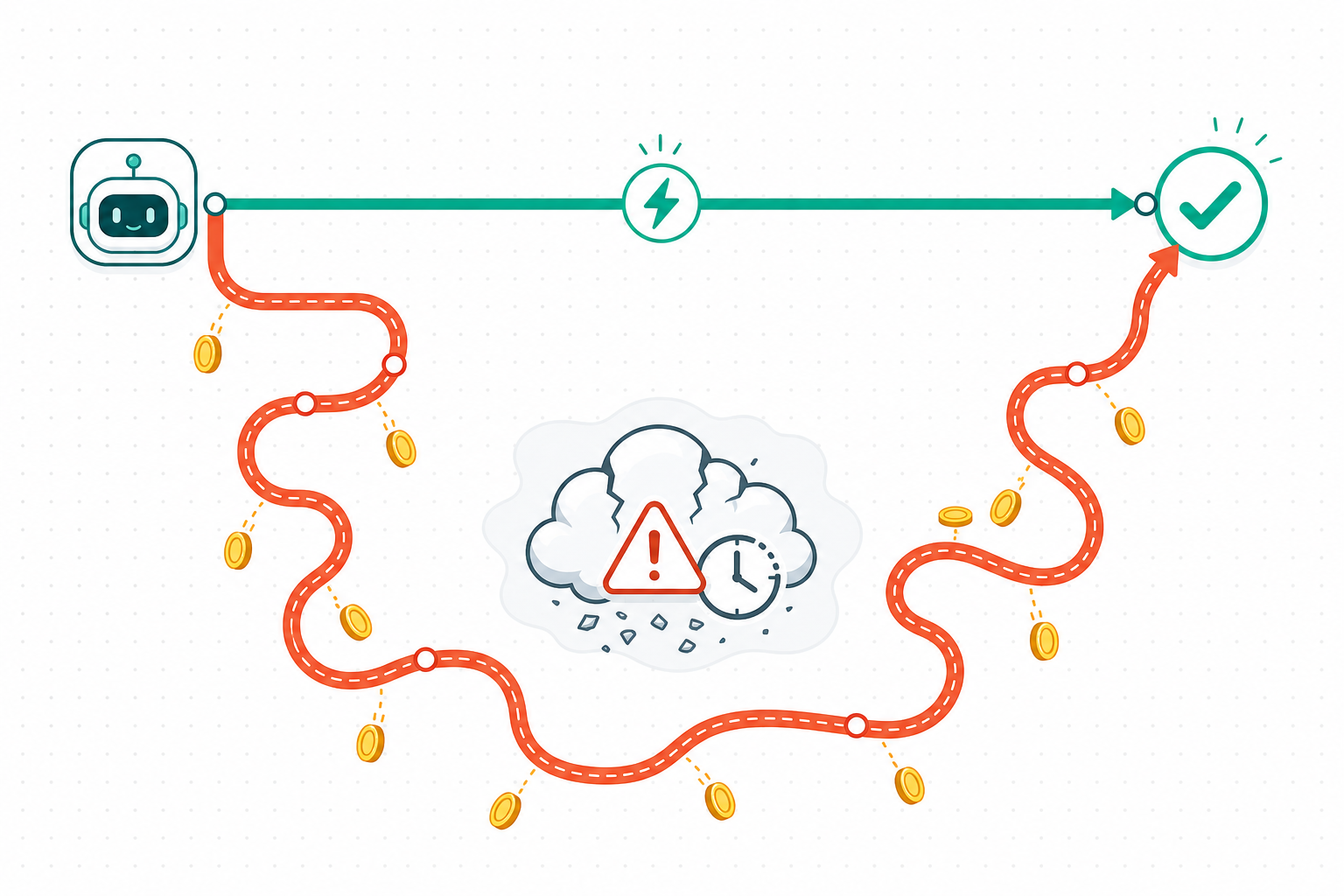
The reflex: build a pipeline first

ETL — Extract → Transform → Load into a warehouse. Then query.
Straight fast path versus long detour dropping coins
ETL assumes questions are known in advance
refreshes nightly — agents need answers now
pays off over years — agents ask once
You can't pre-build a pipeline for a question
nobody has asked yet.
THE FLIP06 / 16

Flip the default: query data where it lives

CLOUD

url('…/orders.parquet')

ARCHIVE

file('…tar :: *.csv')

PROCESS RAM

Python(tickets)
chDB

chDB engine

inside your Python process
one SQL · written at ask-time
Copying becomes an optimization — not a toll you pay first.
CHDB07 / 16

chDB: a rocket engine on a bicycle

A rocket engine strapped to a bicycle
# pip install chdb
import chdb
chdb.query("SELECT count()
  FROM file('orders.parquet')")
# schema inferred · nothing loaded
The ClickHouse engine, in-process — like SQLite
No server, no config, no connection string
Schema on read — point at a file and query

Same engine that runs analytics at Anthropic, Cursor, Vercel, Cloudflare.

TABLE FUNCTIONS08 / 16

One function per place your data lives

file()

72 formats · tar & glob

s3() / url()

lakes & HTTP endpoints

postgresql()

live DBs, queried in place

Python()

the DataFrame in RAM
SELECT type, round(avg(price)) AS avg_price
FROM s3('https://…/house_0.parquet')
GROUP BY type ORDER BY avg_price DESC
-- detached 286,753 · flat 198,888 · terraced 157,110
2.77M rows of UK housing,
queried where they sit.
70 table functions · 72 input formats
counted from the engine, not the brochure

Ran live during prep. Also in there: iceberg(), deltaLake(), hudi(), gcs(), azureBlobStorage()…

THESIS09 / 16

The whole talk in one query

CLOUD

url('…/orders.parquet')

ARCHIVE

crm_exports.tar :: *.csv

PROCESS RAM

Python(tickets)
SELECT name, tier, subject, sum(amount) AS spend FROM Python(tickets) JOIN file('crm_exports.tar :: users_*.csv') USING JOIN url('https://auxten.com/…/orders.parquet') USING GROUP BY name, tier, subject ORDER BY spend DESC
No warehouse.
No load step.
The pipeline is the query.

…and yes: it read the CSVs inside the tar. No unzip.

→ user_58 · pro · api limits · 3,716   (measured output)
THE TOOL10 / 16

Give the agent one data tool

@tool
def run_sql(query: str) -> str:
  """Files, S3, archives, DataFrames —
  one SQL surface for all of it."""
  return chdb.query(query, "CSV")
 agent session
Which of today's tickets are from our biggest customers?
Querying all three sources…SELECT … FROM Python(tickets) JOIN file('…tar…') JOIN url('…parquet…')
user_58 (pro) and user_3 (enterprise) top the list — refund & API-limit tickets.
One tool replaces N connectors. The SQL is the audit log.
PRODUCTION11 / 16

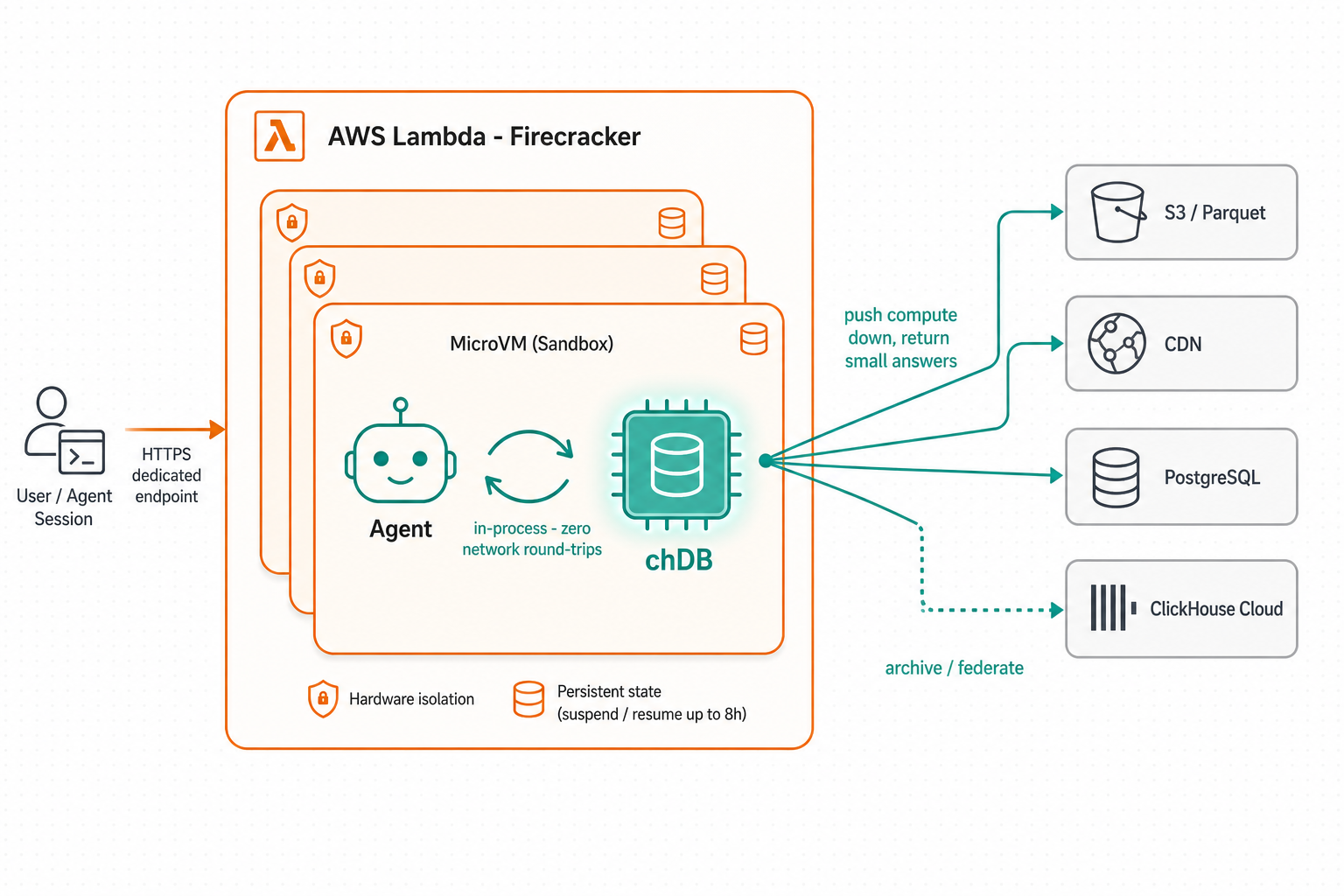
Where it runs: a Lambda per session

Each isolated Lambda MicroVM carries its own private chDB and federates out to S3, CDN, PostgreSQL, ClickHouse Cloud
chDB: the only data-infra launch partner of AWS Lambda MicroVMs
spin up — agent + private chDB
federate S3 / DBs in place
answer, then suspend
The agent's data pipeline is a serverless function with a query engine inside.
PERFORMANCE12 / 16

It reads what the query needs — not the file

house_0.parquet · 33 MB · 2.77M rows · 14 columns    ▼ HTTP Range reads
type
price
date
town
street
…9 more columns
footer
fetched for avg(price) BY type   ■ skipped   ■ footer = schema + stats, read first
4.8 s
count() — footer only; just downloading the file takes 54.6 s
2 / 14
columns fetched for the aggregation — ranged reads, no full scan
344 vs 975 MB
peak RAM, chDB streaming vs pandas — a 33 MB file becomes a 1.5 GB DataFrame
Ranged reads: you pay for the columns you touch — not the file.
ENGINE13 / 16

Same 43 queries. Very different engines.

chDB
×1.09
MongoDB
×95.6
SQLite
×183.6
PostgreSQL
×346.2
MySQL
×364.5

ClickBench · 43 analytical queries · relative total runtime, lower is better · benchmark.clickhouse.com

vs pandas: on DataFrame ops (100K–10M rows), chDB takes the most wins at every size — chart on auxten.com

OLTP databases are great at OLTP. Analytics wants a columnar engine.
HONESTY14 / 16

The network is not free

~60 s
remote aggregation over the 2.77M-row Parquet on S3
1 line
of SQL to materialize it into a local table
19 ms
the same aggregation, after caching locally
-- when a remote path gets hot, cache it — once:
CREATE TABLE hot_orders ENGINE = MergeTree ORDER BY tuple()
AS SELECT * FROM s3('https://…/orders/*.parquet');
ETL didn't disappear. It shrank to one line, applied only where it's hot.
CLOSE15 / 16

Three takeaways

01

Agents ask unpredictable questions. Query data where it lives — don't pre-build pipelines.

02

One SQL surface is the agent's data tool. Files, lakes, archives, DataFrames — federated in-process.

03

Materialize only what gets hot. ETL becomes a one-line optimization, not a prerequisite.

S3 is where your data lives. chDB is how your agent reaches it. Lambda is where it thinks.
Terima kasih!

Thank you.

pip install chdb
github.com/chdb-io/chdb
clickhouse.com/docs/chdb
auxten.com — slides & verified demos
chDB
Q&A
Auxten Wang · ClickHouse · Creator of chDB@auxten